
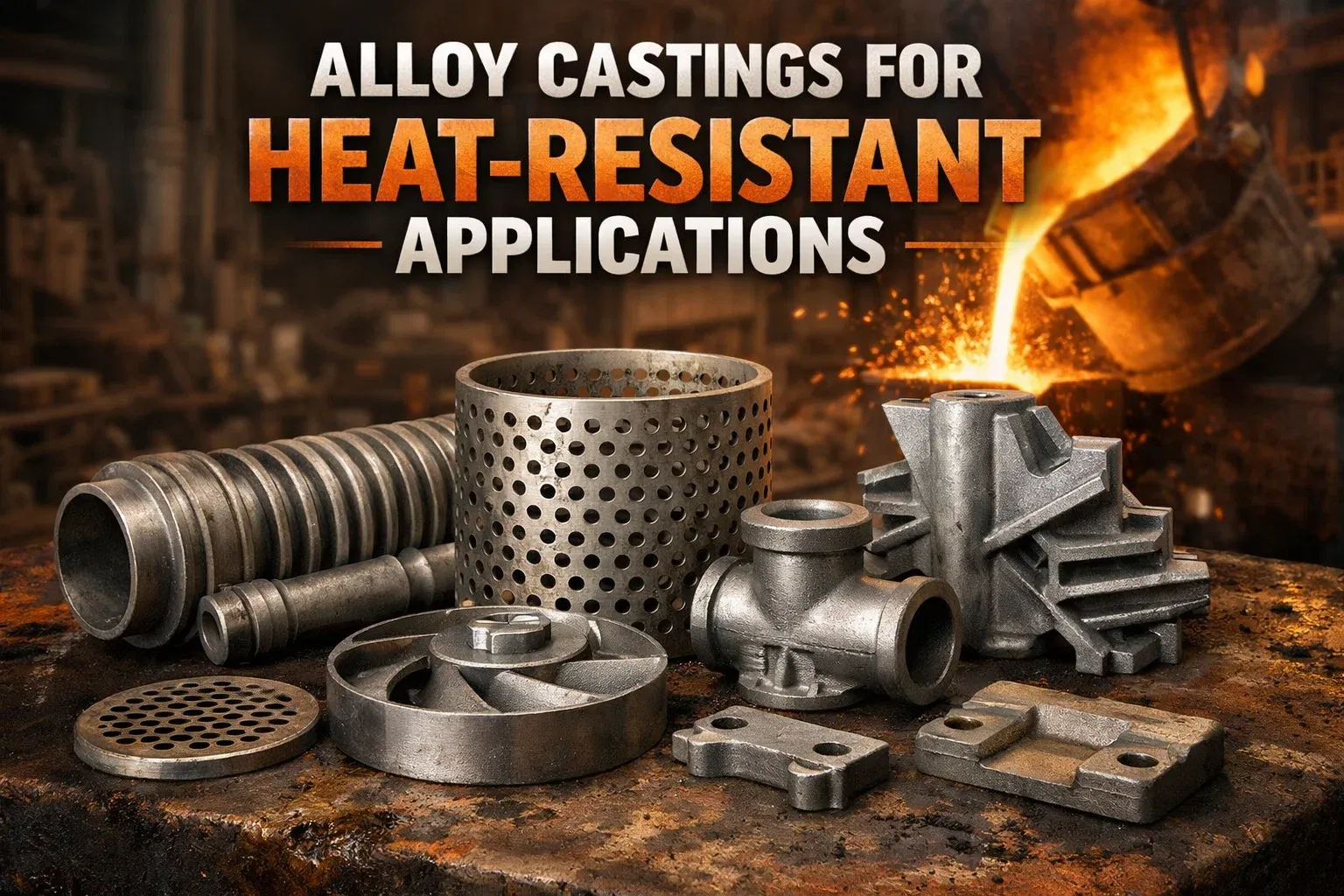
Alloy Casting is a foundational manufacturing technology that plays an indispensable role in producing heat‑resistant components for advanced industrial applications. In industries such as aerospace, automotive, power generation, and petrochemical, materials must withstand extreme temperatures without degrading. This is where Alloy Casting becomes essential. By carefully selecting alloy compositions and refining casting processes, engineers achieve superior mechanical performance and thermal stability.
Alloy Casting involves melting selected metals and alloys, pouring them into molds, and allowing them to solidify into precise, high‑strength shapes. What distinguishes it from other material processes is its adaptability and capability to produce complex geometries that can endure intense thermal environments.
In this extensive guide, we will explore the principles, materials, techniques, benefits, and applications of Alloy Casting, especially in heat‑resistant contexts. Whether you are an engineer, buyer, student, or industry professional, this article will enrich your understanding of how it empowers modern engineering solutions.
The Science Behind Alloy Casting
What Is Alloy Casting?
Alloy Casting refers to the process of shaping molten alloys—mixtures of two or more metals—into specific forms using molds. Unlike pure metals that may lack the necessary strength or heat tolerance, alloys combine the best properties of their constituents to achieve enhanced performance.
When discussing it for heat‑resistant applications, the focus is on alloys that maintain structural integrity at elevated temperatures. These often include nickel‑based superalloys, cobalt alloys, stainless steels, and specialized ferrous and non‑ferrous combinations.
How Alloy Casting Works
The typical it process involves several key steps:
- Material Selection – Choosing the right alloy composition based on required thermal, mechanical, and chemical properties.
- Melting – Heating the metals in a furnace until they form a homogeneous liquid.
- Mold Preparation – Creating molds (sand, ceramic, or metal) that define the part’s final shape.
- Pouring – Transferring molten alloy into the mold with precision.
- Solidification and Cooling – Allowing the alloy to cool and solidify into the desired form.
- Finishing and Inspection – Removing the casting from the mold and performing machining, heat treatment, or quality inspection.
Each step must be meticulously controlled to ensure optimal performance in heat‑intensive environments.
Types of Alloys Used in Heat‑Resistant Casting
Nickel‑Based Alloys
Nickel‑based alloys are leaders in heat resistance and strength at high temperatures. They exhibit excellent corrosion resistance and retain mechanical properties in harsh environments like gas turbines and rocket engines.
Cobalt Alloys
Cobalt alloys are known for their wear resistance and thermal stability. They are commonly used in manufacturing components that require prolonged service life under thermal stress.
Iron‑Based Heat‑Resistant Alloys
Heat‑resistant cast steels and cast iron variants provide cost‑effective solutions for moderate high‑temperature applications such as furnace parts and exhaust systems.
Copper and Bronze Alloys
While copper alloys are typically used for their conductivity, specific bronze formulations are employed where heat and wear resistance must be balanced with good thermal conductivity.
Key Alloy Casting Processes for Heat‑Resistant Components
Sand Casting
Sand casting is one of the most versatile and widely used methods for it. It uses a sand mold formed around a pattern. This process is ideal for large and heavy heat‑resistant parts that do not require extremely tight tolerances.
Advantages:
- Low tooling cost
- Can produce large components
- Suitable for various alloys
Challenges:
- Surface finish may require post‑processing
- Dimensional precision is limited compared to other methods
Investment Casting (Lost Wax Casting)
Investment casting delivers high precision and surface finish. Here, a wax model is coated with refractory material to form a ceramic shell. After the wax is melted away, molten alloy is poured into the cavity.
Benefits:
- Excellent surface finish
- Complex geometries are possible
- Tight dimensional control
Commonly used for aerospace and turbine components where heat resistance and precision are critical.
Die Casting
Die casting uses reusable metal molds and is suitable for high‑volume production. While traditionally applied to lower melting point alloys like aluminum and zinc, advancements allow heat‑resistant it through specialized high‑temperature dies.
Centrifugal and Continuous Casting
Centrifugal casting spins the mold during pouring, forcing molten metal outward to form dense structures. Continuous casting produces long sections like tubes or rods used in heat exchanger applications.
Critical Properties of Heat‑Resistant Alloy Castings
High Temperature Strength
One of the most defining qualities is the ability to retain mechanical integrity at elevated temperatures, often above 800°C (1472°F).
Oxidation and Corrosion Resistance
it for heat‑resistant parts must withstand oxidative environments such as combustion gases without forming detrimental surface layers.
Creep Resistance
Creep—the slow deformation of material under stress at high temperature—is a crucial property. Alloys with high creep resistance prevent premature failure in long‑term service.
Thermal Fatigue Endurance
Thermal cycling is common in heat‑intensive applications. Effective heat‑resistant castings resist cracking under repeated temperature fluctuations.
Applications of Alloy Casting in Heat‑Resistant Scenarios
Power Generation Industry
Alloy Casting components are critical in turbines, boilers, and heat exchangers used in both conventional and renewable power plants. These parts must endure prolonged exposure to high heat and aggressive working conditions.
Aerospace Sector
In aircraft engines, components such as turbine blades and combustion chambers are manufactured using advanced Alloy Casting due to superior heat and stress tolerance.
Petrochemical Plants
Heat‑resistant castings are used in reactors, valves, and piping systems where materials are exposed to hot fluids and corrosive environments.
Automotive Industry
Exhaust manifolds, turbocharger housings, and engine components benefit from Alloy Casting due to thermal loading and cyclic stress.
Choosing the Right Alloy Casting Supplier
Selecting a supplier with proven expertise in heat‑resistant Alloy Casting is vital. Look for manufacturers with:
- Strong metallurgical knowledge
- Quality certifications
- Experience with high‑temperature applications
- Comprehensive testing capabilities
For premium heat‑resistant alloy casting solutions, you can explore Shubh Mangal Technocast, a trusted provider in advanced casting technologies, at https://shubhmangaltechno.com/.
Quality Control in Alloy Casting
Quality assurance is non‑negotiable when it comes to heat‑resistant Alloy Casting. Standard practices include:
- Chemical composition verification
- Dimensional inspection
- Non‑destructive testing (NDT)
- Mechanical testing (tensile, impact, creep)
These checks ensure consistent performance and reliability in critical applications.
Future Trends in Heat‑Resistant Alloy Casting
Advanced Alloys Development
Research continues to develop alloys with greater heat tolerance and reduced environmental impact.
Additive Manufacturing Integration
Additive manufacturing (3D printing) is increasingly used to produce complex casting patterns or hybrid components that complement traditional casting.
AI‑Driven Process Optimization
AI is improving casting quality by enhancing simulation, defect prediction, and process control.
What Makes Alloy Casting Essential for Heat‑Resistant Applications
Alloy Casting is not just a manufacturing method but a strategic solution for components expected to function reliably under severe thermal stress. With the global demand for energy efficiency, lightweight strength, and extended service life, industries increasingly depend on innovative Alloy Casting techniques.
In Part 2 of this comprehensive article, we delve deeper into processing techniques, metallurgical fundamentals, case studies, design strategies, and future directions that elevate Alloy Casting to meet the most demanding heat‑resistant requirements.
Metallurgical Fundamentals Behind Heat‑Resistant Alloys
Crystal Structure and High‑Temperature Behavior
Heat‑resistant materials often exhibit stable crystal structures at elevated temperatures. For example, nickel‑based superalloys maintain strength due to the presence of gamma prime (γ′) precipitates that impede dislocation motion at high temperatures.
Alloying Elements and Their Roles
Critical alloying elements include:
- Chromium (Cr) – Enhances oxidation resistance
- Aluminum (Al) – Forms protective oxide layers
- Molybdenum (Mo) – Improves creep strength
- Titanium (Ti) – Contributes to precipitation hardening
Understanding how these elements interact is fundamental in Alloy Casting for heat‑resistant parts.
Microstructure Control Through Heat Treatment
Post‑casting heat treatment refines microstructure, improves mechanical properties, and enhances resistance to thermal fatigue. Techniques include annealing, solution treatment, and controlled cooling.
Advanced Alloy Casting Techniques for Heat‑Resistant Parts
Directional Solidification
Directional solidification aligns the grain structure to enhance mechanical properties in the primary load direction. This is especially important in turbine blades where stress and heat are concentrated in specific orientations.
Single‑Crystal Casting
Single‑crystal castings eliminate grain boundaries, significantly increasing creep resistance. This cutting‑edge approach is widely used in high‑performance aerospace components.
Vacuum Alloy Casting
Vacuum environments reduce gas entrapment during casting, leading to fewer defects and improved mechanical performance. This technique is common when casting reactive alloys.
Design Strategies for Heat‑Resistant Alloy Castings
Optimizing Geometry for Thermal Performance
Designers must consider wall thickness, heat flow, and stress concentration areas to prevent early failures. Simulation tools now help engineers model thermal behavior prior to casting.
Reducing Thermal Stresses Through Material Selection
Choosing alloys with compatible thermal expansion coefficients avoids internal stresses that lead to cracking during thermal cycling.
Integrating Functional Features
Modern Alloy Casting enables integrated design features such as cooling channels and internal ribs to enhance performance without secondary assembly.
Case Studies: Alloy Casting in Real‑World Applications
Gas Turbine Blades
Gas turbine blades operate in extreme environments exceeding 1000°C (1832°F), requiring alloy castings with exceptional creep resistance and thermal stability.
Exhaust Systems in Heavy‑Duty Vehicles
Alloy Casting produces exhaust manifolds capable of withstanding repeated temperature cycles and corrosive gases without performance degradation.
Petrochemical Reactors
Cast heat‑resistant components in reactors handle hot, corrosive fluids for years, showcasing the value of optimized alloy selection and casting practices.
Sustainability and Environmental Considerations in Alloy Casting
Recycling and Material Efficiency
Many heat‑resistant alloys can be recycled, reducing waste and conserving resources. The casting process itself can reuse molds and gating systems where applicable.
Energy‑Efficient Casting Processes
Advances in furnace technology and process control have reduced energy consumption during Alloy Casting, lowering environmental impact without compromising quality.
Emission Control During Production
Modern foundries implement emission capture and filtering systems to keep air quality compliant and reduce environmental footprint.
Testing and Validation of Heat‑Resistant Alloy Castings
Non‑Destructive Testing (NDT)
NDT methods such as ultrasonic testing, radiography, and dye penetrant inspection detect internal and surface defects without damaging parts.
Creep and Stress Rupture Testing
These tests simulate long‑term exposures to heat and stress, confirming that Alloy Casting components will perform reliably over service life.
Thermal Cycling Tests
Repeated heating and cooling cycles detect weaknesses in design or material selection before field deployment.
Cost Factors in Alloy Casting for Heat Applications
Several variables influence the cost:
- Alloy composition
- Casting method
- Surface finish requirements
- Post‑casting machining and heat treatment
Understanding these factors helps businesses plan investments and manage manufacturing budgets effectively.
How to Choose an Alloy Casting Partner
Selecting the right partner is crucial for high‑temperature applications. A reliable Alloy Casting manufacturer should offer:
- Experienced metallurgical engineers
- Advanced casting facilities
- Strong quality control systems
- On‑time delivery and customization capability
For high‑performance casting solutions backed by technical expertise, consider connecting with Shubh Mangal Technocast — an industry leader known for delivering precision Alloy Casting outcomes.
Future Directions and Innovations in Alloy Casting
AI and Machine Learning Optimization
AI tools are transforming how foundries predict defects, optimize parameters, and enhance quality consistency in Alloy Casting.
Nanostructured and High‑Entropy Alloys
Emerging materials such as high‑entropy alloys combine multiple elements to achieve unprecedented heat resistance and mechanical performance.
Hybrid Manufacturing Methods
Blending additive manufacturing with traditional casting creates opportunities for lightweight, high‑performance components that were previously impractical.
The Enduring Value of Alloy Casting for Heat‑Resistant Needs
Alloy Casting continues to advance industrial capabilities by enabling components that withstand extreme temperatures and demanding environments. Through careful alloy selection, precision processes, and rigorous quality control, engineers deliver solutions that power modern technology across sectors.
From gas turbines to automotive systems, heat exchangers to petrochemical plants, Alloy Casting underpins the performance of essential infrastructure. By staying informed about technological advancements and partnering with capable manufacturers like Shubh Mangal Technocast, industries can confidently meet heat‑resistant challenges of today and tomorrow.