
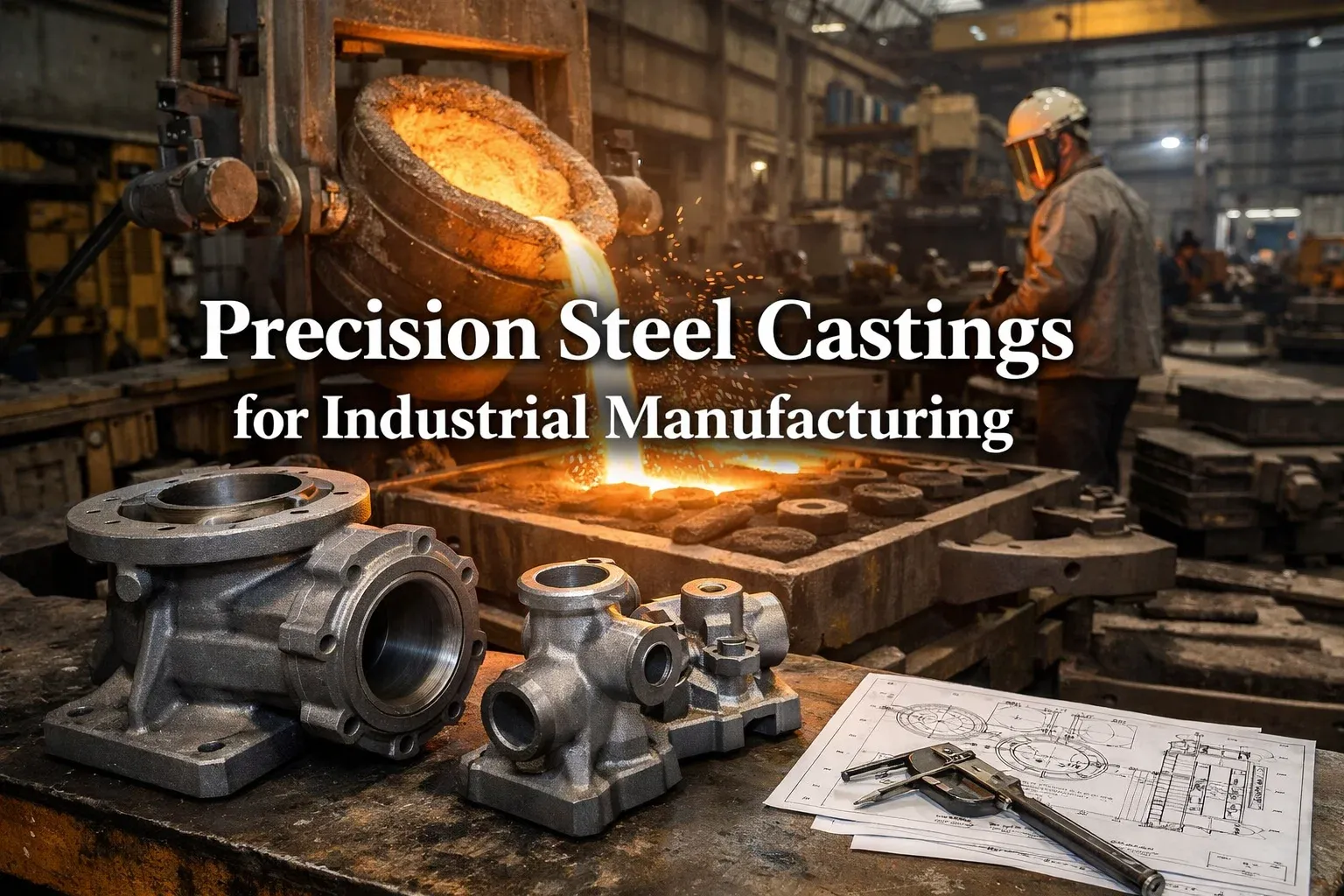
Precision Steel Casting is a critical manufacturing process that supports modern industrial production across multiple sectors. From heavy machinery and automotive systems to energy infrastructure and industrial equipment, manufacturers rely on Precision Steel Casting to deliver components with high strength, dimensional accuracy, and long-term durability.
In industrial manufacturing, components are expected to perform under continuous mechanical stress, high loads, temperature variations, and corrosive environments. Traditional fabrication methods such as welding or machining alone often fall short in meeting these demands. Precision Steel Casting solves this challenge by allowing complex shapes to be produced with consistent quality and excellent mechanical properties.
This comprehensive guide explores how Precision Steel Casting supports industrial manufacturing, its processes, materials, advantages, and real-world applications. It is designed to be technically informative while remaining easy to understand, making it ideal for engineers, procurement teams, and decision-makers seeking reliable casting solutions.
What Is Precision Steel Casting?
Precision Steel Casting is a manufacturing method where molten steel is poured into carefully designed molds to produce highly accurate and complex components. Unlike conventional casting, this process emphasizes tight tolerances, superior surface finish, and predictable metallurgical properties.
The term “precision” refers to the ability to manufacture components that closely match design specifications with minimal deviation. This accuracy reduces the need for extensive machining, lowers production costs, and improves overall efficiency.
It is particularly valuable in industrial manufacturing because it allows designers to integrate multiple features into a single casting, reducing assembly complexity and improving structural integrity.
Why Precision Steel Casting Matters in Industrial Manufacturing
Industrial manufacturing depends on consistency, reliability, and scalability. It plays a vital role because it delivers:
- High structural strength for load-bearing components
- Excellent dimensional stability for complex geometries
- Uniform material properties across large production runs
- Cost efficiency for medium to high-volume manufacturing
Many industrial components must operate continuously for years without failure. It ensures that these components meet stringent mechanical and safety standards while maintaining production efficiency.
Core Steel Grades Used in Precision Steel Casting
The performance of a precision casting depends heavily on the steel grade selected. Industrial manufacturers choose steel grades based on strength, wear resistance, corrosion resistance, and temperature tolerance.
Carbon Steel Castings
Carbon steel is widely used due to its balance of strength, toughness, and affordability. It is suitable for industrial machinery parts, frames, and structural components.
Alloy Steel Castings
Alloy steels include elements such as chromium, nickel, molybdenum, and manganese. These additions enhance mechanical properties, making them ideal for high-stress industrial applications.
Stainless Steel Castings
Stainless steel offers excellent corrosion resistance and is commonly used in chemical processing, food manufacturing, and fluid handling systems.
Precision Steel Casting allows these materials to be shaped into complex components without compromising their inherent properties.
Key Precision Steel Casting Processes
Different casting techniques are used depending on part complexity, production volume, and performance requirements.
Investment Casting
Investment casting, also known as lost wax casting, is widely used inIt. It produces excellent surface finishes and tight tolerances, making it ideal for complex industrial components.
Sand Casting
Sand casting remains a reliable option for large and heavy industrial parts. With modern process control, sand casting can achieve impressive accuracy for industrial applications.
Shell Mold Casting
This process provides better surface finish and dimensional control compared to traditional sand casting, making it suitable for precision industrial parts.
Each process plays a distinct role in industrial manufacturing and is selected based on technical and economic considerations.
Design Flexibility Enabled by Precision Steel Casting
One of the biggest advantages of It is design freedom. Engineers can design parts with internal cavities, complex curves, ribs, and mounting features that would be difficult or expensive to machine.
This design flexibility allows industrial manufacturers to:
- Reduce part count
- Improve component strength
- Enhance functionality
- Lower assembly and maintenance costs
It supports innovation by enabling designs that improve performance while maintaining manufacturability.
Mechanical Properties Achieved Through Precision Steel Casting
Industrial components require predictable mechanical behavior. It delivers consistent properties such as:
- High tensile and yield strength
- Excellent fatigue resistance
- Impact toughness
- Wear resistance
Controlled cooling, alloy selection, and post-casting heat treatment ensure that each casting meets industrial standards and application requirements.
Role of Heat Treatment in Precision Steel Casting
Heat treatment is an essential step in achieving optimal performance. Processes such as annealing, normalizing, quenching, and tempering are applied after casting to refine grain structure and enhance mechanical properties.
Through heat treatment, It components gain improved hardness, ductility, and resistance to fatigue, making them suitable for demanding industrial environments.
Quality Control in Precision Steel Casting
Industrial manufacturing demands strict quality control. It involves comprehensive inspection and testing to ensure compliance with specifications.
Common quality checks include:
- Chemical composition analysis
- Dimensional inspection
- Non-destructive testing
- Mechanical testing
These measures ensure that every component performs reliably throughout its service life.
Industrial Applications of Precision Steel Casting
It is used across a wide range of industrial sectors.
Heavy Machinery and Equipment
Components such as housings, brackets, and load-bearing structures rely on precision cast steel for strength and durability.
Energy and Power Generation
Turbine components, valve bodies, and structural supports benefit from the reliability.
Automotive and Transportation
Precision-cast steel parts are used in braking systems, suspension components, and drivetrain assemblies.
Mining and Construction
High-impact and wear-resistant components are commonly produced using Precision Steel Casting for harsh operating environments.
Choosing the Right Precision Steel Casting Manufacturer
Selecting a capable manufacturer is critical for industrial success. A reliable It partner offers technical expertise, advanced production facilities, and consistent quality standards.
For industrial-grade precision casting solutions backed by engineering expertise, Shubh Mangal Technocast delivers reliable and high-quality manufacturing services. Learn more at https://shubhmangaltechno.com/.
Advanced Engineering in Precision Steel Casting
Precision Steel Casting continues to evolve as industrial manufacturing adopts smarter and more efficient production methods. Advanced simulation software, process optimization, and metallurgical innovation allow manufacturers to produce castings with superior accuracy and performance.
By combining engineering design with casting expertise, Precision Steel Casting supports complex industrial systems that demand reliability under extreme conditions.
Process Simulation and Digital Manufacturing
Modern foundries use simulation tools to predict metal flow, solidification patterns, and potential defects before production begins. This digital approach reduces scrap rates and improves consistency.
Simulation-driven Precision Steel Casting ensures optimal mold design, proper gating systems, and controlled cooling behavior, leading to higher-quality industrial components.
Dimensional Accuracy and Tolerance Control
Industrial assemblies require components that fit together precisely. Precision Steel Casting achieves tight tolerances that reduce or eliminate secondary machining operations.
Improved accuracy leads to:
- Faster assembly
- Reduced production costs
- Improved product reliability
This makes Precision Steel Casting an efficient solution for industrial manufacturing at scale.
Surface Finish and Post-Processing
Surface quality is critical for components involved in sealing, fluid flow, or mechanical contact. Precision Steel Casting produces smoother surfaces compared to traditional methods, improving performance and longevity.
Post-processing options such as machining, grinding, and coating further enhance surface characteristics to meet specific industrial requirements.
Corrosion and Wear Resistance in Industrial Environments
Industrial components often operate in corrosive or abrasive conditions. Precision Steel Casting enables alloy customization to improve resistance against chemicals, moisture, and friction.
This adaptability ensures longer service life and reduced maintenance costs for industrial systems.
Sustainability and Resource Efficiency
Precision Steel Casting supports sustainable manufacturing by minimizing material waste and enabling recycling of steel. Efficient casting designs reduce excess material usage while maintaining strength.
Modern foundries also adopt energy-efficient furnaces and environmentally responsible practices, aligning Precision Steel Casting with sustainable industrial goals.
Cost Efficiency in Industrial Production
While initial tooling may require investment, Precision Steel Casting offers long-term cost advantages through:
- Reduced machining
- Lower assembly complexity
- Consistent production quality
- Reduced failure rates
For industrial manufacturers focused on lifecycle cost optimization, Precision Steel Casting is a strategic choice.
Testing and Validation for Industrial Reliability
Industrial components must meet rigorous performance standards. Precision Steel Casting undergoes extensive testing, including fatigue testing, load testing, and environmental exposure analysis.
These tests confirm that cast components meet operational demands before deployment in industrial systems.
Customization and Scalability
Precision Steel Casting supports both low-volume specialized components and high-volume industrial production. This scalability makes it suitable for prototype development as well as mass manufacturing.
Customization options allow manufacturers to tailor castings to specific applications without compromising production efficiency.
Future Trends in Precision Steel Casting
The future of Precision Steel Casting is driven by innovation.
Key trends include:
- Integration of AI for defect prediction
- Development of high-performance steel alloys
- Hybrid manufacturing combining casting and additive processes
- Increased automation for consistency and efficiency
These advancements will further strengthen the role of Precision Steel Casting in industrial manufacturing.
Precision Steel Casting as an Industrial Backbone
Precision Steel Casting remains a cornerstone of industrial manufacturing due to its ability to produce strong, accurate, and reliable components. Its adaptability, cost-effectiveness, and performance advantages make it indispensable across industries.
By leveraging advanced engineering, quality control, and sustainable practices, Precision Steel Casting continues to support the evolving needs of industrial production. Partnering with experienced manufacturers such as Shubh Mangal Technocast ensures that industrial businesses receive dependable solutions tailored to their technical requirements.