
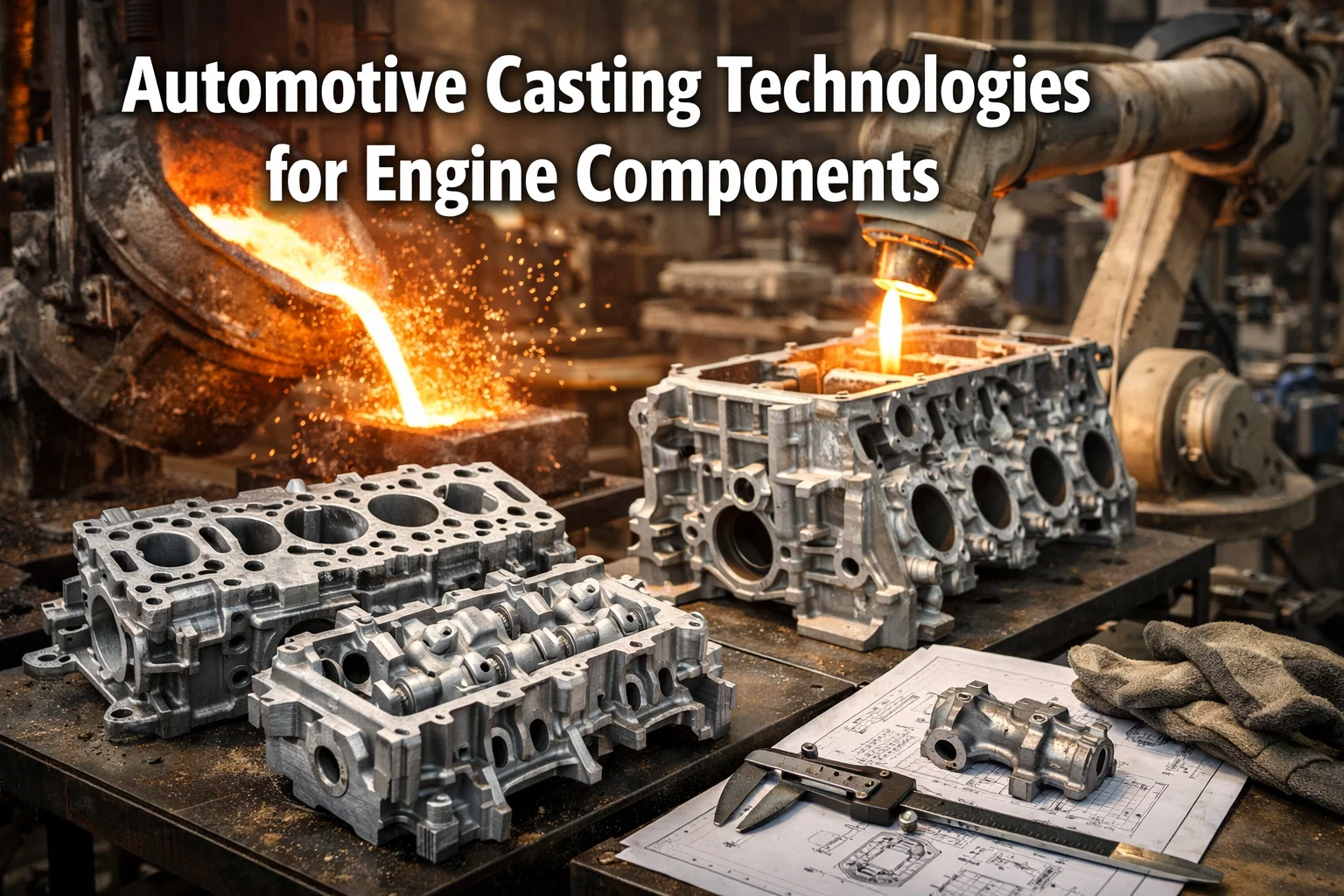
The automotive industry has evolved rapidly over the last few decades, driven by performance demands, fuel efficiency standards, emission regulations, and lightweight engineering requirements. At the core of this transformation lies the continuous advancement of Automotive Casting Technologies, which play a vital role in manufacturing durable, precise, and high-performance engine components.
Engine components operate under extreme conditions, including high temperatures, pressure variations, friction, and mechanical stress. To withstand these challenges, manufacturers rely on advanced casting solutions that ensure structural integrity, dimensional accuracy, and long-term reliability. Automotive Casting Technologies enable the production of complex engine parts while maintaining consistent quality across production cycles.
From traditional internal combustion engines to modern hybrid and electric vehicle platforms, casting technologies remain a foundation of automotive engineering. As engine designs become more compact and performance-oriented, the importance of precision-driven casting processes continues to grow.
What Are Automotive Casting Technologies?
Automotive Casting Technologies refer to specialized metal casting processes used to manufacture engine and vehicle components with precise geometries and controlled material properties. These technologies allow molten metal to be shaped into complex forms that would be difficult or costly to produce using machining alone.
Casting processes support high-volume as well as specialized production, making them suitable for mass-market vehicles and performance-oriented engines alike. By leveraging advanced tooling, controlled cooling, and metallurgical optimization, automotive casting ensures consistency, durability, and efficiency.
In engine manufacturing, Automotive Casting Technologies are commonly used to produce blocks, cylinder heads, manifolds, housings, brackets, and structural supports that must meet strict automotive standards.
Importance of Casting in Engine Component Manufacturing
Engine components are exposed to continuous thermal cycles and mechanical loads. Any defect or dimensional inconsistency can significantly impact engine efficiency and lifespan. Automotive Casting Technologies address these challenges by enabling precise control over metal flow, solidification, and microstructure.
Casting allows engineers to design lightweight yet strong components that improve fuel efficiency and reduce emissions. Modern engine designs often integrate multiple functions into a single casting, minimizing assembly complexity and potential failure points.
By using optimized casting methods, manufacturers can achieve enhanced strength-to-weight ratios, improved heat dissipation, and reduced vibration levels. This makes Automotive Casting Technologies indispensable for modern engine development.
Key Engine Components Manufactured Using Automotive Casting Technologies
Engine Blocks
Engine blocks form the structural foundation of an engine. Automotive Casting Technologies enable the production of engine blocks with complex internal passages for coolant and lubrication. Precision casting ensures uniform wall thickness and minimal porosity, which enhances durability.
Cylinder Heads
Cylinder heads require precise airflow channels, valve seats, and combustion chambers. Advanced casting techniques allow manufacturers to achieve intricate designs while maintaining tight tolerances and surface quality.
Exhaust and Intake Manifolds
Manifolds are exposed to extreme temperatures and pressure fluctuations. Automotive Casting Technologies support the use of heat-resistant alloys that maintain strength and stability under harsh operating conditions.
Transmission and Engine Housings
Housings protect critical engine and transmission components. Casting enables lightweight yet robust designs that reduce noise, vibration, and harshness.
Materials Used in Automotive Casting Technologies
Material selection plays a critical role in the performance of cast engine components. Automotive Casting Technologies support a wide range of metals and alloys tailored to specific applications.
Cast Iron Alloys
Cast iron remains widely used for engine blocks due to its excellent wear resistance, vibration damping, and cost-effectiveness. Modern casting techniques enhance its strength and thermal performance.
Aluminum Alloys
Aluminum is increasingly preferred for engine components due to its lightweight properties and superior heat dissipation. Automotive Casting Technologies enable the production of aluminum engine blocks and cylinder heads with high precision.
Steel and Alloy Steels
Steel castings offer exceptional strength and toughness, making them suitable for high-load components. Precision steel casting improves fatigue resistance and dimensional stability.
Heat-Resistant Alloys
Turbocharged and high-performance engines rely on heat-resistant alloys for exhaust components. Advanced casting processes ensure consistent microstructure and durability.
Casting Processes Used in Automotive Engine Manufacturing
Sand Casting
Sand casting is one of the most widely used Automotive Casting Technologies for large engine components. It allows flexibility in design and supports complex internal structures.
Die Casting
Die casting delivers high dimensional accuracy and smooth surface finishes. It is commonly used for aluminum engine components produced in high volumes.
Investment Casting
Investment casting is used for precision-critical components. It produces near-net-shape parts with minimal machining requirements.
Shell Molding
Shell molding offers improved surface quality and tighter tolerances compared to traditional sand casting, making it suitable for medium-complexity engine parts.
Each process is selected based on component design, material requirements, and production volume.
Design Advantages of Automotive Casting Technologies
One of the biggest advantages of Automotive Casting Technologies is design flexibility. Engineers can incorporate complex internal channels, weight-reducing features, and integrated mounting points directly into cast components.
This design freedom reduces the number of individual parts, improves assembly efficiency, and enhances overall engine performance. Casting also supports near-net-shape production, which minimizes material waste and machining time.
Advanced simulation tools further optimize casting designs, reducing defects and improving yield rates.
Precision and Quality Control in Automotive Casting
Quality control is a critical aspect of Automotive Casting Technologies. Engine components must meet stringent automotive standards for safety, performance, and durability.
Modern foundries use advanced inspection techniques such as dimensional measurement, X-ray testing, and metallurgical analysis. These methods ensure that cast components meet exact specifications and perform reliably throughout their service life.
Consistent quality control reduces warranty risks and enhances customer confidence in engine performance.
Role of Automotive Casting Technologies in Performance and Efficiency
Engine efficiency depends heavily on component precision and thermal management. Automotive Casting Technologies enable optimized designs that improve airflow, combustion efficiency, and heat dissipation.
Lightweight cast components reduce overall vehicle weight, improving fuel economy and lowering emissions. High-strength castings also enhance engine durability, allowing manufacturers to meet performance targets without compromising reliability.
As automotive engineering continues to advance, casting technologies remain central to achieving performance and sustainability goals.
Sustainability and Environmental Impact
Sustainability is becoming increasingly important in the automotive sector. Automotive Casting Technologies support eco-friendly manufacturing through efficient material usage and metal recyclability.
Advanced casting processes reduce scrap rates and energy consumption. Aluminum and steel alloys used in casting are highly recyclable, contributing to circular manufacturing practices.
By optimizing production efficiency, casting technologies help manufacturers reduce their environmental footprint while maintaining high-quality standards.
Digital Simulation and Process Optimization
Digital tools play a crucial role in modern Automotive Casting Technologies. Casting simulation software predicts metal flow, cooling behavior, and potential defect formation before production begins.
These simulations enable engineers to optimize designs, reduce trial-and-error, and improve casting quality. Digital process control ensures consistency across large production runs and enhances overall efficiency.
Simulation-driven casting supports faster development cycles and improved product reliability.
Future Trends in Automotive Casting Technologies
The future of Automotive Casting Technologies is shaped by electrification, lightweight design, and advanced materials. As electric vehicles gain popularity, casting processes are being adapted to produce battery housings, motor casings, and structural components.
Innovations such as high-pressure die casting, advanced alloys, and hybrid manufacturing techniques are driving the next generation of automotive components. These advancements ensure that casting remains a cornerstone of automotive manufacturing.
Role of Automotive Casting Technologies in Modern Engine Performance
As engine architectures become more compact, powerful, and efficient, the role of Automotive Casting Technologies has expanded significantly. Modern engines demand components that can handle higher combustion pressures, elevated temperatures, and reduced friction while maintaining long service life. Casting technologies provide the structural integrity and design flexibility required to meet these challenges.
Precision-driven casting enables optimized airflow paths, integrated cooling channels, and lightweight geometries that directly impact engine performance. By using advanced casting methods, manufacturers can improve torque output, fuel efficiency, and thermal stability across a wide range of engine platforms.
The adaptability of Automotive Casting Technologies makes them suitable for traditional combustion engines, hybrid systems, and emerging electric powertrains.
Heat Treatment Processes for Cast Engine Components
Heat treatment plays a critical role in enhancing the mechanical properties of cast engine components. After casting, components undergo controlled thermal processes to improve strength, hardness, wear resistance, and fatigue life.
Common heat treatment methods used alongside Automotive Casting Technologies include:
- Annealing for stress relief and improved machinability
- Normalizing for uniform grain structure
- Quenching and tempering for increased strength and toughness
These processes ensure that cast components can withstand cyclic loads, thermal shock, and long-term operational stress commonly experienced in engine environments.
Surface Finishing and Functional Enhancement
Surface quality is essential for engine components that interact with fluids, gases, and moving parts. Automotive Casting Technologies produce near-net-shape components, but finishing processes further enhance performance and durability.
Surface finishing techniques include shot blasting, polishing, coating, and surface hardening. These treatments improve corrosion resistance, reduce friction, and enhance fatigue strength. In exhaust and turbocharger components, surface treatments also improve thermal resistance and oxidation control.
By combining precision casting with advanced finishing, manufacturers achieve superior functional performance and extended component life.
Automotive Casting Technologies in High-Performance Engines
High-performance and racing engines place extreme demands on materials and manufacturing precision. Automotive Casting Technologies enable the production of high-strength, lightweight components capable of handling aggressive operating conditions.
Turbo housings, exhaust manifolds, and performance cylinder heads rely on advanced alloys and controlled casting processes. Precision casting ensures consistent wall thickness, reduced porosity, and optimized microstructure, all of which are critical for performance engines.
These technologies support innovation in motorsports and high-end automotive engineering.
Electric and Hybrid Vehicle Applications
As the automotive industry transitions toward electrification, Automotive Casting Technologies are being adapted to support new component requirements. Electric vehicles require lightweight structural parts, battery housings, motor casings, and thermal management systems.
Casting enables the integration of cooling channels and structural reinforcements into single components, reducing assembly complexity. Aluminum and specialized alloys are commonly used to meet weight and thermal performance targets.
Hybrid vehicles also benefit from casting solutions for engine components that must operate efficiently alongside electric systems.
Quality Assurance in Automotive Casting Technologies
Quality assurance is fundamental to the success of Automotive Casting Technologies, particularly for engine components that affect safety and performance. Foundries employ comprehensive inspection and testing protocols to ensure reliability.
Key quality control methods include:
- Dimensional inspection using coordinate measuring machines
- Radiographic testing to detect internal defects
- Ultrasonic testing for structural integrity
- Metallurgical analysis for alloy verification
These practices ensure that every casting meets automotive industry standards and customer specifications.
Cost Efficiency and Scalability
One of the major advantages of Automotive Casting Technologies is their ability to balance cost efficiency with scalability. Casting processes support both high-volume production and specialized low-volume requirements without compromising quality.
By reducing machining operations and material waste, casting lowers overall production costs. Integrated designs minimize assembly steps, further improving manufacturing efficiency.
Scalable casting solutions allow manufacturers to adapt production volumes based on market demand, making them ideal for both mass-market and premium vehicle segments.
Supply Chain Reliability and Consistency
Automotive manufacturers rely on consistent quality and timely delivery of engine components. Automotive Casting Technologies support stable production workflows through standardized processes and robust quality control systems.
Reliable casting partners ensure consistent metallurgy, dimensional accuracy, and repeatability across production batches. This consistency is critical for maintaining engine performance and reducing warranty risks.
Strong supply chain integration enhances operational efficiency and supports long-term manufacturing partnerships.
Sustainability and Environmental Responsibility
Environmental considerations are increasingly influencing automotive manufacturing decisions. Automotive Casting Technologies support sustainability by optimizing material usage and enabling metal recycling.
Advanced casting processes reduce scrap rates and energy consumption. Aluminum and steel alloys used in automotive casting are highly recyclable, contributing to circular manufacturing practices.
By improving efficiency and reducing waste, casting technologies help manufacturers meet environmental regulations and sustainability goals.
Why Shubh Mangal Technocast for Automotive Casting Technologies
Shubh Mangal Technocast delivers reliable and high-quality casting solutions tailored to automotive engine applications. With deep expertise in metallurgy, process control, and quality assurance, the company supports manufacturers across diverse automotive segments.
By leveraging advanced Automotive Casting Technologies, Shubh Mangal Technocast ensures consistent performance, durability, and precision in every component. Their engineering-focused approach enables optimized designs and efficient production.
Learn more about their automotive casting capabilities by visiting https://shubhmangaltechno.com/
Future Outlook of Automotive Casting Technologies
The future of Automotive Casting Technologies is driven by innovation in materials, digital simulation, and manufacturing automation. Emerging trends include giga casting, advanced aluminum alloys, and AI-driven process optimization.
As vehicle designs continue to evolve, casting technologies will play a key role in meeting performance, efficiency, and sustainability targets. Continuous improvement in casting methods ensures their relevance in next-generation automotive platforms.