Rajkot as a Growing Hub for Automotive Investment Casting
India’s automotive industry is one of the largest in the world, supplying vehicles, components, and systems to both domestic and international markets. At the heart of this supply chain lies precision manufacturing, where accuracy, durability, and consistency are critical. Among the various manufacturing methods, automotive components investment casting has emerged as a preferred solution for producing complex and high-performance automotive parts. Rajkot, located in Gujarat, has become a key center for this specialized manufacturing process.
Rajkot is widely known for its strong engineering culture, skilled workforce, and growing foundry ecosystem. Over the years, the city has evolved from traditional casting practices to advanced investment casting techniques that meet global automotive standards. Today, many OEMs and Tier-1 suppliers rely on manufacturers in Rajkot for high-quality automotive components investment casting, benefiting from precision, scalability, and cost efficiency.
This blog explores why Rajkot is a preferred destination for automotive investment casting, how the process supports modern vehicle design, and how manufacturers like Shubh Mangal Technocast contribute to the production of reliable automotive components.
Understanding Investment Casting in the Automotive Industry
Investment casting, also known as the lost-wax process, is a precision manufacturing method used to create metal components with intricate shapes and tight tolerances. The process begins with a wax pattern that mirrors the final part. This pattern is coated with ceramic layers to form a mold. Once the wax is removed, molten metal is poured into the cavity, resulting in a highly accurate casting.
In the automotive sector, automotive components investment casting is used to manufacture parts that demand complex geometry, excellent surface finish, and consistent metallurgical properties. Unlike conventional sand casting or forging, investment casting allows for greater design freedom, enabling engineers to optimize component performance and reduce weight.
Rajkot-based manufacturers have mastered this process by integrating modern equipment, automation, and quality control systems. This expertise makes the city a trusted source for high-precision automotive castings.
Why Automotive Manufacturers Prefer Investment Casting
The automotive industry operates under intense pressure to improve efficiency, reduce emissions, and enhance safety. These demands require components that are both lightweight and strong. Automotive components investment casting supports these goals by allowing manufacturers to produce near-net-shape parts that require minimal machining.
One of the biggest advantages of investment casting is its ability to produce complex internal geometries. Automotive parts such as housings, brackets, and connectors often require intricate designs that improve functionality while reducing material usage. Investment casting delivers these designs with high repeatability.
Additionally, investment casting offers superior surface finish, which improves fatigue resistance and reduces wear. This is especially important for automotive components that operate under dynamic loads and high temperatures.
Rajkot’s Strength in Automotive Investment Casting
Rajkot has developed into a strong industrial cluster for automotive manufacturing. The city benefits from access to raw materials, skilled technicians, and supportive infrastructure. Over time, manufacturers in Rajkot have invested heavily in upgrading their facilities to meet international automotive quality standards.
A key reason why buyers choose Rajkot for automotive components investment casting is the balance between quality and cost. Manufacturers offer competitive pricing without compromising on precision or reliability. This makes Rajkot an attractive sourcing destination for both Indian and global automotive companies.
Another advantage is flexibility. Rajkot-based manufacturers can handle both low-volume prototyping and high-volume production, making them suitable partners for new vehicle development programs as well as mass production.
Automotive Components Commonly Produced Using Investment Casting
Investment casting supports a wide range of automotive applications. Components produced through automotive components investment casting must meet strict dimensional and performance requirements.
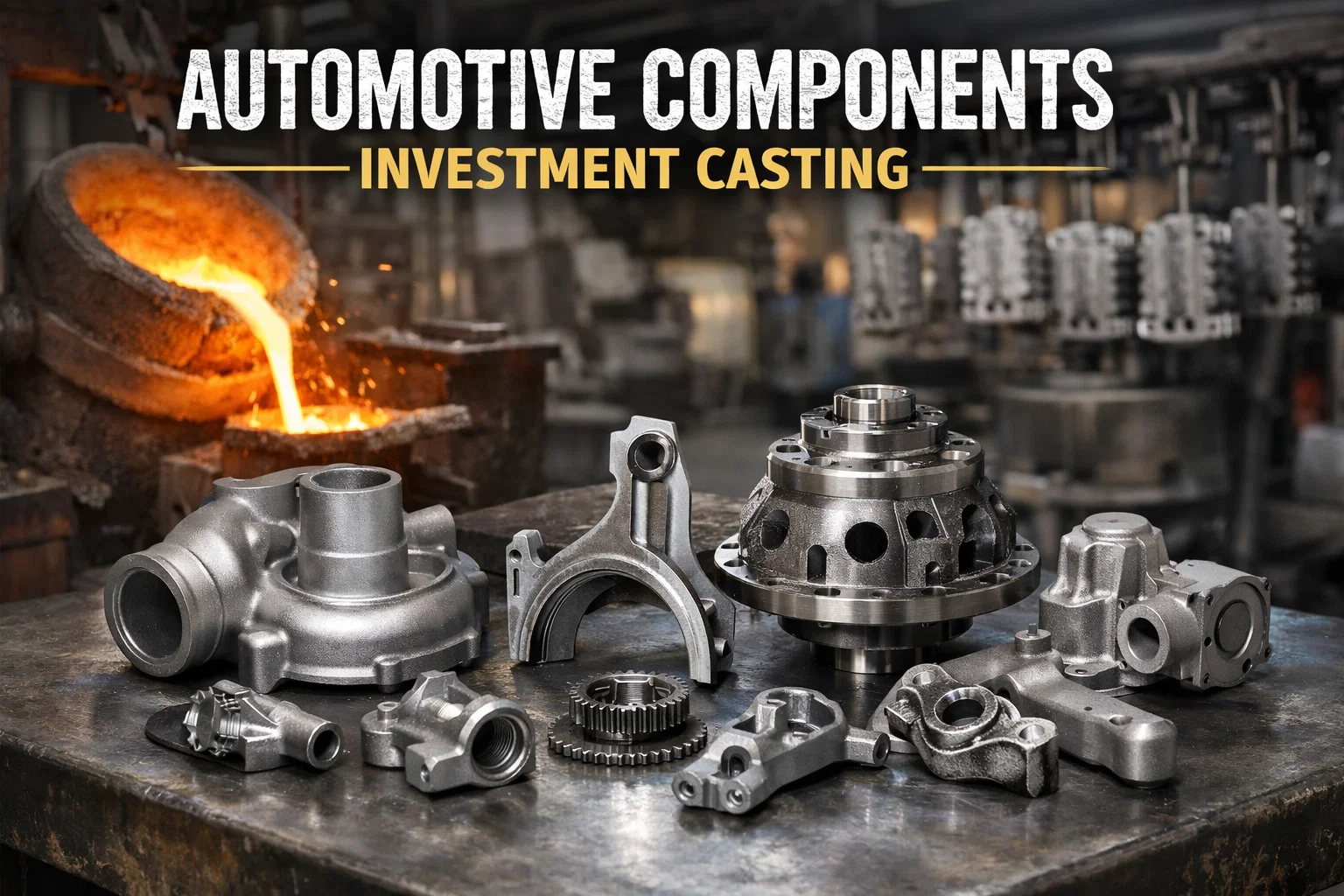
Common automotive parts manufactured using investment casting include:
- Engine brackets and housings
- Turbocharger components
- Transmission and gearbox parts
- Exhaust system components
- Suspension and steering parts
- Sensor housings and mounting brackets
- Differential and drivetrain components
These components benefit from the precision and repeatability of investment casting, ensuring consistent performance across production batches.
Material Selection for Automotive Investment Casting
Material selection is critical in automotive manufacturing. Components must withstand heat, vibration, corrosion, and mechanical stress. Investment casting allows manufacturers to work with a wide range of alloys tailored to specific automotive requirements.
Common materials used in automotive components investment casting include carbon steel, alloy steel, stainless steel, and special heat-resistant alloys. Stainless steel is often used for exhaust and emission-related components due to its corrosion resistance, while alloy steels are preferred for structural and load-bearing parts.
Rajkot manufacturers work closely with automotive engineers to select the right material based on application requirements, ensuring optimal performance and durability.
Design Optimization and Engineering Support
Modern automotive manufacturing relies heavily on design optimization. Investment casting provides unmatched flexibility for engineers to design components that meet functional and regulatory requirements.
Through advanced CAD and simulation tools, manufacturers analyze metal flow, solidification behavior, and stress distribution. This allows them to optimize the design before production begins. In automotive components investment casting, such simulations help reduce defects, improve yield, and ensure structural integrity.
Design optimization also supports weight reduction, a key goal in automotive engineering. By eliminating unnecessary material, manufacturers help improve fuel efficiency and reduce emissions without sacrificing strength.
Quality Control in Automotive Investment Casting
Quality assurance is non-negotiable in the automotive industry. Components must meet strict safety and performance standards. Rajkot-based manufacturers implement comprehensive quality control systems to ensure every casting meets specifications.
For automotive components investment casting, quality checks begin with raw material inspection and continue through every stage of production. Dimensional accuracy is verified using advanced inspection tools such as coordinate measuring machines.
Non-destructive testing methods, including radiography and dye penetrant inspection, are used to detect internal and surface defects. These measures ensure that automotive components are reliable and fit for demanding applications.
Role of Rajkot Manufacturers in the Global Automotive Supply Chain
Rajkot’s automotive casting manufacturers play an important role in the global supply chain. Many companies export investment-cast automotive components to Europe, North America, and other international markets.
Global customers value Rajkot manufacturers for their technical capability, consistent quality, and reliable delivery schedules. This export exposure has further strengthened the expertise of local companies in automotive components investment casting.
Compliance with international standards and customer-specific requirements has become a core strength of Rajkot-based manufacturers, making them competitive on a global scale.
Shubh Mangal Technocast: A Trusted Name in Automotive Investment Casting
Among the companies contributing to Rajkot’s reputation in precision manufacturing, Shubh Mangal Technocast stands out for its commitment to quality and customer satisfaction. The company specializes in producing reliable automotive cast components using advanced investment casting techniques.
With modern manufacturing facilities, skilled professionals, and strict quality control systems, Shubh Mangal Technocast delivers consistent results for diverse automotive applications. Its focus on process control and continuous improvement aligns with the demanding requirements of automotive components investment casting.
To learn more about their capabilities and automotive casting solutions, you can visit Shubh Mangal Technocast at https://shubhmangaltechno.com/. This single reference provides insight into how Rajkot-based manufacturers support the automotive industry with precision investment casting.
Benefits of Choosing Rajkot for Automotive Components Investment Casting
Choosing Rajkot as a sourcing destination offers several advantages. Manufacturers provide a strong balance of quality, cost efficiency, and scalability. This is particularly important for automotive companies operating in competitive markets.
Automotive components investment casting in Rajkot supports faster development cycles, reduced machining costs, and improved component performance. The availability of skilled manpower and modern infrastructure further enhances production reliability.
As automotive technology continues to evolve, Rajkot manufacturers remain well-positioned to support new designs and performance requirements.
Looking Ahead: Future of Automotive Investment Casting in Rajkot
The future of automotive manufacturing will demand even greater precision, lighter components, and improved sustainability. Investment casting is well-suited to meet these challenges.
Rajkot-based manufacturers are investing in automation, digital quality systems, and advanced alloys to stay ahead of industry trends. This ensures that automotive components investment casting from Rajkot will continue to meet global standards.
Advanced Manufacturing Technologies Used in Automotive Investment Casting
As automotive engineering evolves, manufacturers must adopt advanced technologies to meet rising expectations for safety, efficiency, and durability. In Rajkot, leading manufacturers of automotive components investment casting have moved beyond traditional foundry methods and embraced modern manufacturing technologies.
Advanced wax injection systems ensure precise replication of component geometry, which is critical for maintaining dimensional consistency. Automated ceramic shell building systems improve uniformity and reduce variability between batches. These technologies help manufacturers achieve repeatable results, especially for complex automotive components produced in high volumes.
Simulation software plays a crucial role in modern automotive components investment casting. Engineers simulate metal flow, solidification patterns, and cooling behavior before actual production. This proactive approach minimizes casting defects such as shrinkage, porosity, and hot tears. By identifying potential issues early, manufacturers reduce scrap rates and ensure higher yield.
Automation and digital monitoring also allow real-time tracking of process parameters, improving overall quality and productivity. These advancements position Rajkot as a competitive hub for automotive investment casting.
Importance of Dimensional Accuracy in Automotive Components
Automotive components must fit precisely within assemblies that often involve multiple interconnected systems. Even minor dimensional deviations can affect performance, safety, and durability. This is why automotive components investment casting is preferred for parts requiring high accuracy.
Investment casting allows manufacturers to achieve tight tolerances with minimal machining. Uniform wall thickness and controlled solidification help maintain dimensional stability across production batches. This consistency is particularly important for engine components, transmission parts, and structural brackets.
Rajkot-based manufacturers use advanced inspection tools such as coordinate measuring machines and optical measurement systems to verify dimensional accuracy. These practices ensure that every automotive component meets exact specifications and integrates seamlessly into vehicle assemblies.
Heat Treatment and Mechanical Performance
Heat treatment is a critical step in determining the mechanical properties of automotive components. After casting, components undergo controlled heat treatment processes such as annealing, normalizing, quenching, and tempering.
In automotive components investment casting, heat treatment enhances strength, hardness, fatigue resistance, and impact toughness. Different automotive applications require different mechanical characteristics, and Rajkot manufacturers tailor heat treatment cycles accordingly.
Precise control over temperature and time ensures consistent results across batches. Metallurgical testing and microstructural analysis further confirm that components meet required performance standards. This attention to detail ensures long-term reliability of automotive cast parts under real-world operating conditions.
Machining and Finishing of Automotive Cast Components
Although investment casting produces near-net-shape components, certain automotive applications require additional machining to meet tight tolerance or surface finish requirements. Rajkot manufacturers integrate CNC machining centers with casting operations to maintain accuracy and efficiency.
Machining operations may include drilling, tapping, milling, and turning, depending on component design. These processes ensure that automotive components investment casting meets functional and assembly requirements.
Finishing processes such as shot blasting, grinding, and polishing improve surface quality and remove residual imperfections. These steps enhance corrosion resistance, fatigue life, and aesthetic appearance, making components suitable for demanding automotive environments.
Quality Assurance Systems in Automotive Investment Casting
Quality assurance is a cornerstone of automotive manufacturing. Components must meet stringent industry standards and perform reliably over long service lives. Rajkot-based manufacturers implement comprehensive quality management systems to ensure consistent results.
In automotive components investment casting, quality checks begin with raw material inspection and continue through every production stage. Chemical composition analysis ensures correct alloy selection, while mechanical testing verifies strength and durability.
Non-destructive testing methods such as radiography, ultrasonic testing, and dye penetrant inspection detect internal and surface defects. These rigorous inspection procedures ensure that only defect-free automotive components reach customers.
Applications of Automotive Investment Cast Components
Automotive investment casting supports a wide range of vehicle applications. Components manufactured using automotive components investment casting are used in passenger cars, commercial vehicles, electric vehicles, and off-highway equipment.
Engine and powertrain components require high strength and thermal resistance. Exhaust system parts must withstand high temperatures and corrosive gases. Suspension and steering components demand durability and fatigue resistance. Investment casting meets these diverse requirements by enabling precise control over geometry and material properties.
As vehicles become more advanced, the demand for precision investment-cast components continues to grow.
Role of Rajkot Manufacturers in Global Automotive Supply Chains
Rajkot manufacturers play an important role in global automotive supply chains. Many companies export investment-cast automotive components to international markets, including Europe, North America, and Asia.
Global OEMs value Rajkot manufacturers for their technical expertise, consistent quality, and competitive pricing. Compliance with international standards and customer-specific requirements has become a key strength of automotive components investment casting in Rajkot.
Export exposure also drives continuous improvement, as manufacturers must consistently meet strict quality and delivery expectations.
Shubh Mangal Technocast’s Contribution to Automotive Investment Casting
Shubh Mangal Technocast reflects the qualities expected from a reliable automotive investment casting manufacturer in Rajkot. The company focuses on precision manufacturing, strict process control, and customer-centric service.
By investing in modern equipment, skilled manpower, and advanced inspection systems, Shubh Mangal Technocast ensures consistent quality across automotive casting projects. Its experience in automotive components investment casting allows it to support diverse applications with reliable and durable solutions.
The company’s emphasis on quality, engineering collaboration, and timely delivery makes it a trusted partner for automotive manufacturers seeking dependable casting solutions.
Cost Efficiency and Scalability in Automotive Casting
Cost efficiency is a critical factor in the automotive industry. Investment casting helps reduce production costs by minimizing machining and material waste. Near-net-shape production lowers labor requirements and shortens lead times.
Rajkot manufacturers offer scalable production capabilities, supporting both prototype development and large-scale manufacturing. This flexibility is especially valuable for automotive companies launching new models or adapting to changing market demands.
Through automotive components investment casting, manufacturers achieve an optimal balance between quality, performance, and cost.
Sustainability in Automotive Investment Casting
Sustainability is becoming increasingly important in automotive manufacturing. Rajkot-based investment casting companies are adopting environmentally responsible practices to reduce energy consumption and waste.
Recycling of wax and ceramic materials, energy-efficient melting systems, and optimized water usage contribute to sustainable operations. These initiatives help reduce environmental impact while maintaining production efficiency.
Sustainable manufacturing practices enhance the long-term viability of automotive components investment casting and align with global environmental goals.
Future Trends in Automotive Components Investment Casting
The future of automotive manufacturing will demand lighter, stronger, and more efficient components. Investment casting is well-positioned to meet these requirements.
Advancements in alloy development, digital manufacturing, and predictive quality analytics will further enhance automotive components investment casting capabilities. Electric vehicles and hybrid platforms will also drive demand for specialized cast components with unique performance characteristics.
Rajkot manufacturers who invest in innovation and technology will continue to play a key role in shaping the future of automotive manufacturing.
Rajkot has firmly established itself as a trusted destination for automotive components investment casting. With advanced manufacturing technologies, skilled workforce, and strong quality systems, the city supports the production of high-performance automotive components for global markets.
Investment casting enables manufacturers to deliver complex geometries, consistent quality, and reliable performance, making it ideal for modern automotive applications. Companies like Shubh Mangal Technocast demonstrate how precision, process control, and customer focus can create long-term value for the automotive industry.
As automotive technology continues to evolve, investment casting in Rajkot will remain a critical contributor to innovation, efficiency, and reliability.