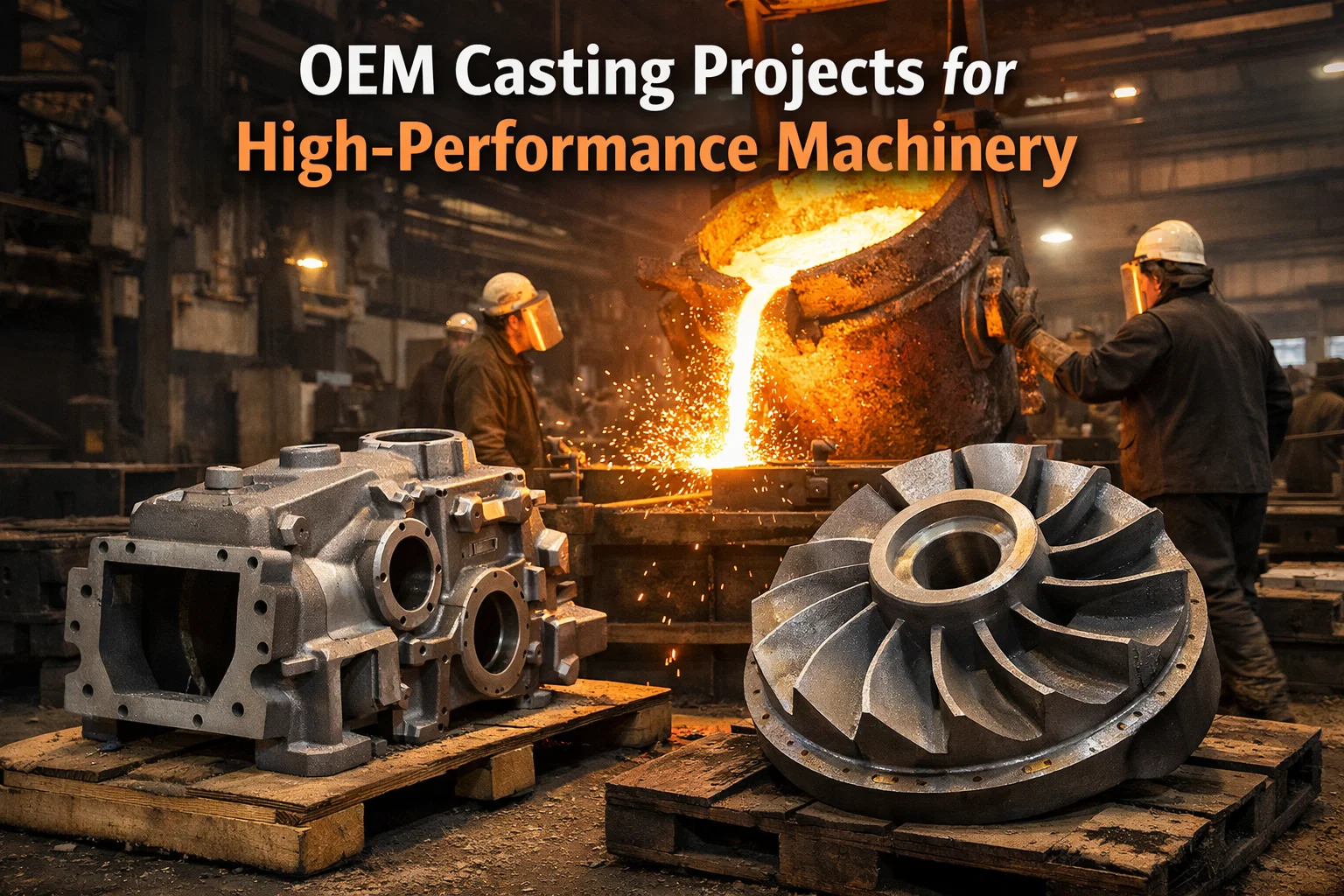
In today’s industrial landscape, high-performance machinery requires components that are precise, durable, and capable of withstanding extreme operational conditions. OEM Casting is the cornerstone technology that enables manufacturers to meet these rigorous demands. By producing custom-designed metal parts with exceptional mechanical properties, OEM Casting ensures that machinery performs optimally under high stress, temperature, and wear conditions.
OEM Casting is widely used in automotive, aerospace, power generation, and heavy industrial sectors. By working with experienced manufacturers like Shubh Mangal Technocast (https://shubhmangaltechno.com/), companies can access tailored casting solutions for complex and high-precision components.
This guide will explore the complete ecosystem of OEM Casting projects for high-performance machinery, including processes, materials, advantages, applications, and quality control, providing an in-depth understanding for engineers, procurement teams, and industrial professionals.
What is OEM Casting?
OEM Casting refers to the process of manufacturing custom metal parts specifically designed for Original Equipment Manufacturers (OEMs). These castings are engineered to meet exact specifications, including size, strength, thermal properties, and durability. Unlike standard casting, OEM Casting focuses on high precision and consistency to integrate seamlessly into high-performance machinery.
The primary goals of OEM Casting include:
- Achieving precise dimensions for complex components
- Ensuring consistent mechanical and thermal performance
- Reducing post-casting machining requirements
- Meeting industry-specific regulatory and quality standards
OEM Casting plays a crucial role in reducing assembly complexity, enhancing equipment longevity, and improving operational efficiency in high-performance machinery.
Importance of OEM Casting in High-Performance Machinery
High-performance machinery operates in demanding environments where standard manufacturing methods cannot always meet requirements. OEM Casting is vital because:
- Custom Engineering: Each casting is designed for the unique requirements of the machinery.
- Durability: High-strength alloys and controlled casting processes ensure components can withstand high stress and wear.
- Complex Geometries: OEM Casting allows intricate shapes that are difficult to achieve through traditional machining.
- Consistency: Repeatable processes guarantee uniform quality across multiple production runs.
By leveraging OEM Casting, manufacturers can optimize machinery performance while minimizing downtime and maintenance costs.
Common Materials Used in OEM Casting Projects
The choice of material significantly affects the performance of OEM Casting components. Some common materials include:
- Carbon Steel: Widely used for structural and load-bearing parts due to its balance of strength and cost-efficiency.
- Alloy Steel: Enhanced mechanical properties make it suitable for high-stress components.
- Stainless Steel: Offers superior corrosion resistance, ideal for fluid handling systems and harsh environments.
- Nickel and Cobalt Alloys: Used in extreme temperature or wear-resistant applications.
The material selection in OEM Casting projects is guided by the operational requirements, environmental conditions, and desired service life of machinery components.
Key OEM Casting Processes
Various casting processes are employed depending on component complexity, production volume, and material type:
1. Sand Casting
Sand casting is flexible and cost-effective for producing large components. Modern sand casting techniques allow tight tolerances and improved surface finishes suitable for OEM projects.
2. Investment Casting
Also known as lost-wax casting, this process excels in producing intricate, high-precision components for high-performance machinery. It is widely used in aerospace, automotive, and energy applications.
3. Die Casting
Die casting is optimal for high-volume production, producing parts with excellent surface quality and dimensional accuracy. High-pressure die casting ensures repeatability and consistency.
4. Shell Mold Casting
Shell mold casting offers better dimensional accuracy and surface finish than traditional sand casting, making it suitable for precise OEM components.
5. Centrifugal Casting
Centrifugal casting produces dense, high-integrity components for critical applications, such as rotating machinery parts.
Design Considerations for OEM Casting Projects
Design plays a crucial role in the success of OEM Casting projects:
- Dimensional Accuracy: Essential to fit into high-performance machinery assemblies.
- Weight Optimization: Critical for aerospace and automotive machinery to reduce energy consumption and improve efficiency.
- Thermal Management: Components may need optimized thermal conductivity or heat resistance.
- Stress Distribution: Design must prevent weak points and ensure uniform load-bearing capacity.
Advanced simulation tools are often used to model material flow, solidification patterns, and thermal behavior during OEM Casting.
Mechanical Properties Achieved Through OEM Casting
OEM Casting delivers components with the following mechanical properties:
- High tensile and yield strength
- Excellent wear and corrosion resistance
- Thermal stability under extreme temperatures
- Fatigue and creep resistance
These properties are vital for high-performance machinery operating under continuous load, vibrations, and fluctuating environmental conditions.
Applications of OEM Casting in High-Performance Machinery
OEM Casting is widely adopted across multiple industries:
Automotive Industry
Custom engine blocks, transmission housings, and suspension components benefit from the precision and strength offered by OEM Casting.
Aerospace
Critical components like turbine blades, landing gear parts, and structural assemblies rely on high-integrity OEM Casting.
Energy & Power Generation
Boiler parts, turbine housings, and pump components require OEM castings that can endure high temperatures and mechanical stress.
Heavy Machinery & Construction Equipment
Hydraulic components, gear housings, and structural parts are manufactured using OEM Casting to meet durability and performance requirements.
Quality Assurance in OEM Casting
OEM Casting projects require strict quality control measures to ensure component reliability:
- Material Verification: Ensuring chemical composition matches design specifications.
- Dimensional Checks: Precision measurement of complex geometries.
- Non-Destructive Testing (NDT): Ultrasonic, radiography, and dye penetrant testing detect defects without damaging components.
- Mechanical Testing: Tensile, impact, and fatigue tests confirm performance under operational loads.
By adhering to rigorous quality standards, OEM Casting components deliver consistent performance in high-performance machinery.
Advantages of OEM Casting for Industrial Applications
OEM Casting offers several benefits over other manufacturing methods:
- Reduced machining and assembly requirements
- Ability to produce complex geometries
- Consistent mechanical and thermal performance
- Cost-effective for small and large production runs
- High durability and longevity of components
For reliable OEM Casting solutions tailored to high-performance machinery, companies often turn to Shubh Mangal Technocast (https://shubhmangaltechno.com/), which specializes in advanced casting technologies.
Future Trends in OEM Casting Projects
The future of OEM Casting is shaped by technology and innovation:
- Advanced Alloys: New materials provide enhanced heat resistance, wear resistance, and structural performance.
- Additive Manufacturing Integration: 3D printing can produce complex patterns or hybrid components for casting.
- AI and Process Optimization: Machine learning predicts defects and optimizes parameters for consistent quality.
- Sustainability: Energy-efficient furnaces and recyclable alloys make OEM Casting more environmentally responsible.
These trends are driving the evolution of high-performance It projects in modern industrial manufacturing.
Advanced Techniques in OEM Casting
High-performance machinery demands components that are precise, strong, and reliable. Modern OEM Casting projects employ advanced techniques to achieve superior quality and functionality.
Directional Solidification
Directional solidification aligns the grain structure of the metal during casting. This technique improves mechanical strength, creep resistance, and fatigue life of components used in high-load applications. It projects utilizing directional solidification are common in turbine components, pump housings, and structural machinery parts.
Vacuum Casting
Vacuum casting minimizes gas entrapment during the casting process. This improves the density and integrity of the casting, reducing porosity and potential defects. For It in high-performance machinery, vacuum casting ensures superior reliability and long-term performance.
Single-Crystal Casting
In extremely high-performance applications, such as aerospace turbines, single-crystal casting eliminates grain boundaries, increasing resistance to creep and thermal fatigue. It projects leveraging this technique produce components that endure high temperature and stress over extended periods.
Simulation-Driven Casting
Advanced CAD and casting simulation software allow engineers to model molten metal flow, solidification, and stress points. This ensures optimal mold design, minimizes defects, and reduces rework. It projects increasingly use simulation tools to enhance consistency and performance.
Material Selection Strategies for OEM Casting
Material selection is critical to ensure component performance in high-performance machinery.
- Carbon Steel – Ideal for structural It components, balancing strength and cost.
- Alloy Steel – Provides enhanced mechanical properties for load-bearing machinery parts.
- Stainless Steel – Resistant to corrosion and ideal for fluid-handling It components.
- Nickel and Cobalt Alloys – High-temperature alloys used in turbines, engine components, and exhaust systems.
Careful selection of materials ensures that It projects meet the specific requirements of each high-performance application.
Cost Efficiency in OEM Casting Projects
While initial tooling for OEM Casting may involve investment, the benefits outweigh the cost:
- Reduced post-casting machining
- Lower assembly complexity
- Predictable performance reduces maintenance costs
- High yield minimizes material waste
Investing in It ensures that high-performance machinery components are durable and cost-efficient over their lifecycle.
Quality Assurance – Best Practices
Quality assurance is a key aspect of successful It projects. Rigorous quality measures include:
- Dimensional Inspection – Ensures precise fit in machinery assemblies.
- Non-Destructive Testing (NDT) – Techniques like ultrasonic and radiography detect internal and surface defects without damaging the component.
- Mechanical and Thermal Testing – Evaluates performance under operational loads and extreme conditions.
- Traceability – Maintaining records for compliance with industry standards.
By adhering to strict quality standards, It projects deliver reliable components that meet high-performance machinery requirements.
Industrial Applications – Case Studies
Automotive Engines
It is widely used in engine blocks, cylinder heads, and transmission housings. Precision casting ensures durability and precise alignment with other components, reducing assembly issues and improving performance.
Aerospace Turbines
Critical aerospace components, such as turbine blades and nozzles, rely on It for high-temperature resistance and structural integrity. This ensures reliability in extreme operational environments.
Heavy Industrial Equipment
Hydraulic cylinders, gear housings, and structural frames benefit from wear-resistant and fatigue-resistant It Components endure harsh operational conditions while maintaining long service life.
Energy & Power Generation
It produces turbine housings, pump casings, and boiler components capable of withstanding high temperatures and pressures, ensuring efficient and safe energy production.
Customization and Scalability of OEM Casting
It offers unmatched flexibility:
- Low-Volume Projects: Tailored solutions for prototypes or specialized machinery parts.
- High-Volume Production: Standardized components for automotive, aerospace, and industrial machinery.
This adaptability makes It suitable for a wide range of machinery applications, from niche projects to mass production.
Sustainability in OEM Casting
Modern It practices prioritize environmental responsibility:
- Use of recyclable alloys reduces waste.
- Energy-efficient furnaces lower carbon footprint.
- Process optimization minimizes material scrap.
Sustainable It meets growing industrial demands while adhering to environmental standards.
Emerging Trends in OEM Casting
- AI and Machine Learning – Predict defects, optimize casting parameters, and improve consistency.
- Hybrid Manufacturing – Combines additive manufacturing with casting for complex geometries.
- Advanced Alloys – Nanostructured and high-performance alloys increase wear and thermal resistance.
- Automation – Enhances consistency, reduces human error, and improves production efficiency.
It continues to evolve to meet the increasing demands of high-performance machinery.
Design Considerations for High-Performance OEM Casting
Effective design is crucial for successful projects:
- Dimensional Accuracy: Critical for assembly integration in complex machinery.
- Weight Optimization: Reduces energy consumption in mobile machinery.
- Thermal Management: Materials and geometry are designed for optimal heat resistance.
- Stress Distribution: Avoids weak points, ensuring structural integrity.
Simulation-driven design ensures that components perform reliably under operational stress.
Challenges in OEM Casting Projects
While provides high value, it also involves challenges:
- Managing complex geometries and thin walls.
- Controlling shrinkage and porosity during solidification.
- Achieving tight tolerances for high-performance machinery.
- Selecting appropriate alloys for extreme operating conditions.
Experienced manufacturers like Shubh Mangal Technocast (https://shubhmangaltechno.com/) overcome these challenges through advanced expertise and modern casting technologies.
Testing and Validation of OEM Casting Components
Rigorous testing is essential to validatecomponents:
- Fatigue Testing: Simulates operational cycles to ensure long-term performance.
- Load Testing: Confirms that components withstand expected mechanical stress.
- Thermal Testing: Verifies material stability under temperature fluctuations.
- Surface Inspection: Ensures finish quality for critical mating surfaces.
These validation processes guarantee that components meet industrial standards and perform reliably in high-performance machinery.
Advantages of OEM Casting for Industrial Machinery
provides numerous benefits:
- High precision and dimensional accuracy
- Complex geometries without extensive machining
- Durable components that resist wear and fatigue
- Cost-effective for both low- and high-volume production
- Reliable integration into high-performance machinery
By using, manufacturers achieve optimal machinery performance with reduced maintenance and operational downtime.
Future Outlook of OEM Casting
The future of It is driven by technological innovation:
- Advanced Alloys: Deliver superior thermal, mechanical, and corrosion resistance.
- AI-Optimized Casting Processes: Improve defect prediction and yield.
- Additive-Casting Hybrids: Enable unprecedented design flexibility.
- Sustainable Practices: Reduce environmental impact while improving efficiency.
It is set to remain a cornerstone technology for producing high-performance machinery components across industries.
It is the backbone of high-performance machinery manufacturing. Its ability to produce complex, durable, and high-precision components makes it indispensable across automotive, aerospace, energy, and industrial sectors. With strict quality assurance, advanced techniques, and expert material selection, projects deliver components capable of performing under extreme conditions.
Partnering with experienced manufacturers like Shubh Mangal Technocast (https://shubhmangaltechno.com/) ensures access to cutting-edge solutions that enhance performance, reliability, and efficiency.
It continues to evolve, integrating advanced alloys, AI-driven processes, and sustainable practices, making it a forward-looking solution for high-performance industrial machinery.